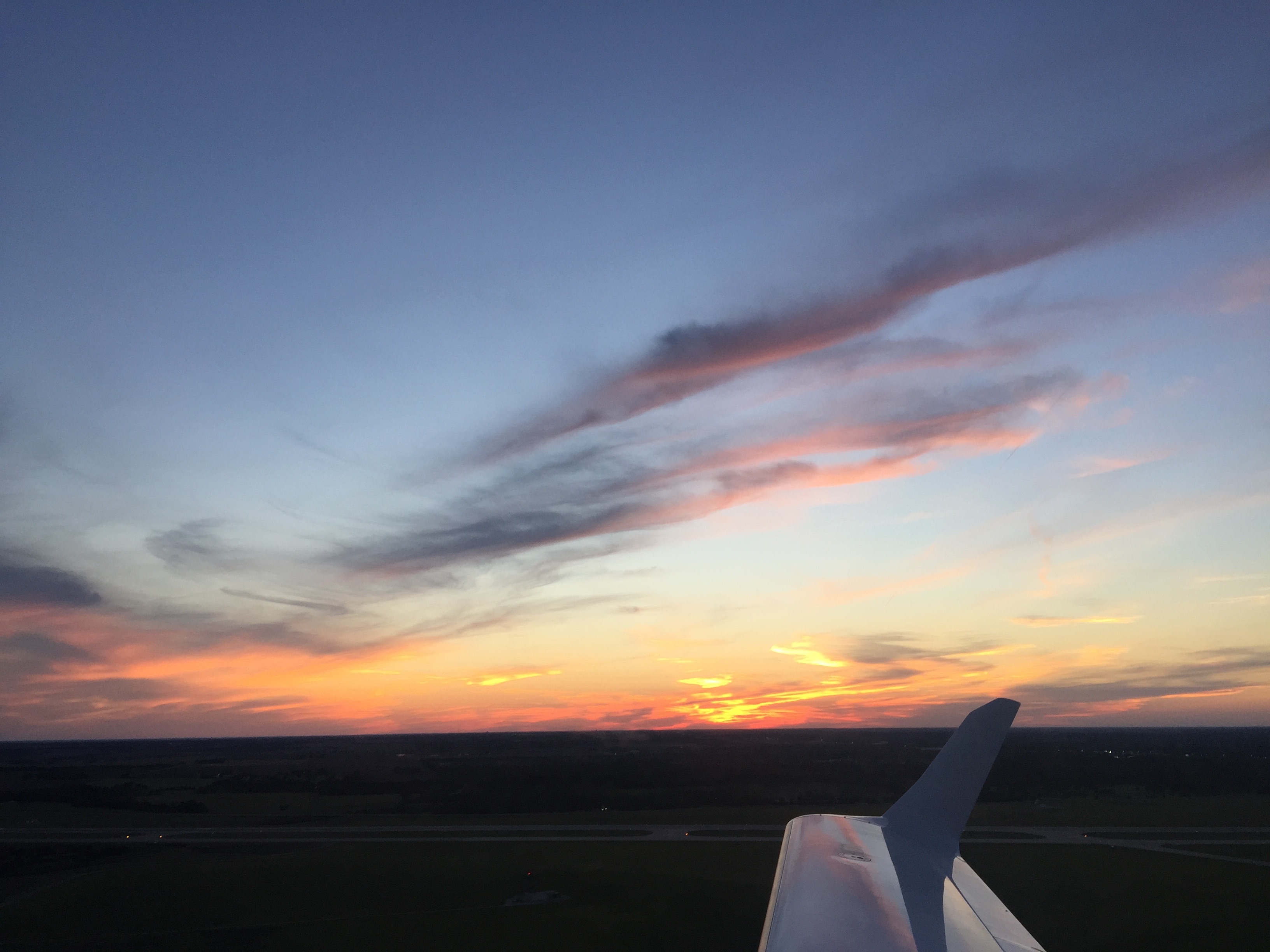
Indy's runways are aligned east-to-west-ish. 230 and 050 on the headings. I was coming from the west flying about a 080 heading (almost due east), so it would be better to land on a zero-five runway (there are two, left and right). So I asked Center controller if that was okay to plan for, they approved it and said they would pass it along. When I switched to the Indianapolis Approach controllers they said that the airport was landing two-three, but they would see if they could "swing it around for me." I figured at midnight the traffic would be light and it wouldn't be an issue.
When I was about ten minutes out they said it would be no problem, to head direct to one of the points on the approach and that I was cleared for the approach. I plugged that in, had already descended to the proper altitude of five thousand feet, and motored on with the autopilot set to intercept the approach.
The ILS (Instrument Landing System) is great because it is a narrow radio beam that provides both horizontal and vertical guidance to the landing point. Although I had activated the approach in the G1000 and I could see it drawn with purple lines on my moving map, the localizer (and glide slope) had not tuned in to be identified. (When you tune in a navigation radio you can listen to it and it will use morse code to identify itself. So if you are going to start the VOR-A approach into Santa Monica, you would tune in the Santa Monica VOR on 110.8 and if you flipped over to your navigation radio you would hear it say dot-dot-dot, dash-dash, dash-dash-dash. which is S-M-O, the identifier for Santa Monica. Now you know you have tuned in the correct radio and you can follow it to the field. Of course, the clever people at Garmin figured out that the radio could get smart enough to do the identifying. So when I tune in a navigation radio, or when the G1000 puts in the frequency for me when I activate an instrument approach, there's a slight delay and then the letters pop up next to the frequency numbers.)
Cleared for the approach, but no radio signal from the airport... I knew I could follow my GPS to the field, but I couldn't figure out what I was doing wrong. I cross-checked the approach plate, briefed the approach a second time (reading it out loud), and tuned the radios myself to check the G1000's work. I'm still six minutes from reaching the approach course, and I am perfectly capable of flying the approach visually or via GPS, but I am curious so I key the radio. "Indy Approach, two-Romeo-Delta is not receiving the localizer for the approach."
"Two-Romeo-Delta we had an airliner coming in on two-three, it should be turned on in a moment and you should have it." He hadn't even finished his transmission and it showed up, bright green needles swinging around to point me to the centerline of the runway.
"You mean the ILS isn't turned on all the time?"
"They can't have both turned on, it can only go one direction at a time."
"Oh, I didn't know that, sorry to make them switch it around."
"No problem at all."
Tonight I learned that an approach is not necessarily active and available at all times that an airport is open.
That's the video of me flying the approach with it all dialed in. With the ILS locked in, the autopilot flew what is called "a coupled approach," where it was following the radio beam along the centerline of the runway and it was keeping the plane sliding down the glide slope to drop the wheels right on the thousand foot markers. I made it more difficult for poor Otto by lowering the landing gear at the final approach fix and then adding a notch of flaps to slow us down. You should be able to see how the huge Indy airport, set on an endless plain, becomes a sea of lights at night. Having some help to find the lights that describe the runway, and where I should land, is a good idea.
The moon rising as I flew east into the night, blood red at first and then lighter and brighter as it came up through the haze of evening was amazing. But I am not that good a photographer.
6 comments
Absolutely. I do IFR flying for a living, and I'm always learning new things. If we waited until we have been taught everything by a CFII to go for the practical test, we'd have very few instrument rates pilots. Look at Europe and what's required over there to get an instrument rating. It's ridiculous.
There's no way a CFII mentioned any of this to me, and that's a great point about avoiding the transition time if you can (I think there might be a charter jet accident down south that was right at opening time a few years ago, wrong runway?). This is why it is so important to keep learning. There's SO much knowledge that affects the safety of flight and no way to get it all in the 40hrs of dual for the private or the additional few for IFR.
It's my understanding that at my local Class Charlie field (KROC), the ability to switch the ILS between reciprocal runways (in this case, between Rwy 22 and Rwy 4) was an upgrade from the days when the ILS was fixed for one runway and only a localizer back course approach was available for the other. Had I not heard that story while training, I don't think that I would have realized that the ILS might not always be active for a particular runway either.
Speaking off turning approaches on and off: A friend of mine flew freight for a time and tells a story about a night landing in Mexico a couple of years ago. He was just a few miles out on the ILS when the clock struck 9:00 pm. This was the official closing time for the airport...so, naturally, ATC turned off the ILS!
I had an incident coming into White Plains, NY like that. It was two minutes prior to the tower's closing time. They were still answering the radio, but said they had transferred control of the ILS and lights already. Well, approach had the other runway's ILS turned on, so we were getting reverse sensing on our HSI. Very confusing. I hate arriving or departing right when a tower opens or closes for just that sort of reason.
Colin, Why don't we see the Approach Lighting System leading to the runway? Is it only active when the ILS is active?
I am pretty sure that all of the lights are also under control of the airport. I didn't ask for the approach lighting and I think I had indicated I was /G and already established on the approach. It was a really clear night so I imagine they figured I didn't need them.